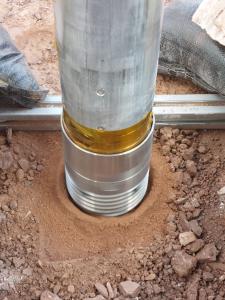
Drill for Extensive Exploration of Planetary Environments by Robots (DEEPER)
Programme Reference
T313-601MM
Status
Closed
Country
United Kingdom
Start Date
2020
End Date
2023
Programme: TDE Prime Contractor: UNIV OF GLASGOW
Subcontractors:
British Antarctic Survey • United Kingdom
Apogee Engineering • United Kingdom
Objectives
Development of a breadboard for a planetary coil tubing drill that will be used for sampling planetary soil down to 20m. The prototype, developed with COTS components, is compatible with principle space constraints and features functions and subsystems to allow a demonstration in a suitable environment.•Development of a breadboard for Martian deep drilling technologies, reaching 20 m in regolith, rocks, permafrost, and ice (to TRL4)•Concept: Using a downhole drill module deployed by an unrolling-tube drill string architecture (no drill string assembly) without use of additional drilling media
Description
EXOMARS features a multi-stem drill, pioneered by the MIRO driller (TRP result in 2001), capable of acquiring samples 2 meters down in the ground. Multi stem drills are the right solution for shallow depths, however for reaching deeper they present problems that are too difficult to solve within the constraint of space missions. Drillers of this type require a cumulated length of pipe as long as the depth reached, which translates into a large mass. Furthermore friction increases with depth so for any drill larger than few meters, the well must be lined. Lining pipes introduce additional mass penalty. An alternative class of Subsurface Explorers or Moles can be considered to serve as deep drillers. These systems eliminate the rigid connection between the surface and the drilling head by allowing the latter to move independently. ESA, has promoted the use of moles in small missions (BEAGLE mole in 2000) Moles can reach deep but they cannot reliably return samples to the surface, hence this activity will develop a drill system with the sample acquisition capability of multi-stem drill and small resources implied by a mole. In terrestrial mining this system is called a coil tubing drill and can be adapted for space use. The activity shall develop a breadboard of planetary coil tubing drill capable of demonstrating acquisition of 2 cmˆ3 of pristine sample at a depth of 20 metres. This activity shall - define requirements for the breadboard- define a preliminary design of the system and its subsystems- prototype critical subsystems to validate the functioning- detail design the prototype- manufacture assemble and integrate the prototype- test and demonstrate the prototype in a suitable environment.
• Application domain: Exploration
•
Technology Domain:
13 - Automation, Telepresence & Robotics
13 - Automation, Telepresence & Robotics
•
Competence Domain:
1-EEE Components, Photonics, MEMS
2-Structures, Mechanisms, Materials, Thermal
3-Avionic Systems
4-Electric Architecture, Power and Energy, EMC
1-EEE Components, Photonics, MEMS
2-Structures, Mechanisms, Materials, Thermal
3-Avionic Systems
4-Electric Architecture, Power and Energy, EMC
• Initial TRL: TRL 1
• Target TRL: TRL 4
• Achieved TRL: TRL 4
•HarmoRoadMap: -
•IPC Document: -
•Public Document: