Analysis of GNSS spaceborne resilience
Programme Reference
T106-602ES
Status
Closed
Country
Austria
Start Date
2020
End Date
2024
Programme: TDE Prime Contractor: JOANNEUM RESEARCH FORSCHUNGSGESELLSCHAFT
Subcontractors:
RUAG SPACE GMBH • Austria
Objectives
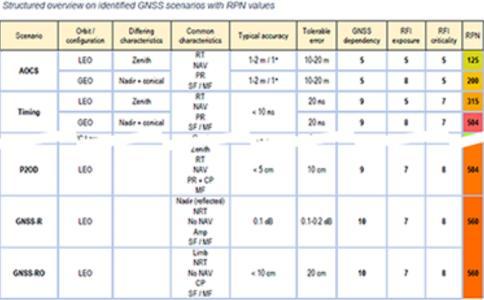
To assess risks and vulnerabilities of GNSS spaceborne receivers and consequences of RF interference to missions relying on position, velocity and time as well as raw measurements and subsequently propose risk mitigation strategies
Description
GNSS (Global Navigation Satellite System) receiver (such as GPS or Galileo receivers) are vulnerable to RF interference, intentional and un-intentional. Ground GNSS receiver have evolved significantly in the last 10 years to be resilience to such problems. GNSS spaceborne receivers are currently a mission critical element in multiple missions, mainly in LEO orbit, but soon also for GTO and GEO. At the same time the basic architecture adopted does not include (or consider only partially) robustness against RF effects. GNSS spaceborne receivers are mission critical elements to multiple space missions in Earth orbit and reliance against RF intentional or un-intentional interference has not been studied, leaving the units potentially vulnerable The activity will assess the risk of RF intentional or un-intentional events that might degrade/disrupt the products generated by GNSS spaceborne receivers (e.g.: Position, velocity and time, as well as raw measurements needed for POD (precise orbit determination) needed for scientific products ? basically needed for all Earth Observation (EO) products). Interference can be particularly critical for EO scientific applications with geometries particularly sensitive to human RF inferference (e.g. From horizon in the case of Radio Occultation, or signals reflected on the Earth for GNSS-R like the proposed for G-TERNS in Earth Explorer 9). Finally the activity will assess the best mitigation solutions that can be applied to spaceborne GNSS receivers to mitigate such issues.
• Application domain: Earth Observation
•
Technology Domain:
6-RF Subsystems, Payloads and Technologies
6-RF Subsystems, Payloads and Technologies
•
Competence Domain:
3-Avionic Systems
3-Avionic Systems
• Initial TRL: TRL 1
• Target TRL: TRL 3
• Achieved TRL: TRL 3
•HarmoRoadMap: On-Board Radio Navigation Receivers (2013.2)
•IPC Document: ESA/IPC(2019)3
•Public Document: