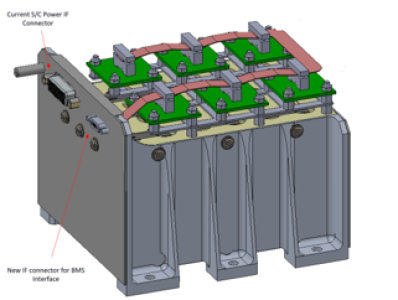
Active Battery management
Programme Reference
T703-601EP
Status
Contracted
Country
Spain
Start Date
2019
End Date
2024
Programme: TDE Prime Contractor: ABENGOA INNOVACION SA
Objectives
To investigate the use of active battery management for suitable missions, understanding the opportunities, constraints and requirements that active battery management would allow
Description
Active battery management is not currently used on ESA missions (apart from reducing End of Charge Voltage during the cruise of deep space missions to increase battery lifetime) but does see some limited use in cubesat programmes. Active battery management is used extensively in terrestrial energy storage. By monitoring the state of charge and voltage of the battery, the power in/out of the battery can be actively managed. This allows several benefits such as sizing a battery more conservatively because different operational modes can be accommodated more easily. Active management also allows utilisation at an optimal depth of discharge and operational state of charge to maximise battery lifetime. Active battery management also allows the introduction of functional overcharge and undercharge control as well as temperature specific usage modes introducing protection modes preventing battery damage in extreme usage.
While active battery management would have limited benefit on missions with a set load cycle, on missions with complex load cycles (missions with non-repeating loads profiles, complex science missions, surface rovers or missions requiring a high level of autonomy) significant benefits are expected, such as reducing battery sizing and significantly improving battery lifetime by smart operational strategy.
Introduction of State of health and state of function monitoring may allow early detection of latent failure modes within the battery as well.
The activity looks at the functionality that active battery management would allow as well as identifying scenarios where this functionality would be beneficial, investigating the feasibility of using the approach in a space environment.
The activity specifically encompasses the following tasks:
- Definition and consolidation of function list for battery management system
- Identification of scenarios that would benefit from battery management functionality
- Identification of monitoring and signal processing requirement to support functions
- Identification of additional hardware to support functions
- Assessment of operation of a battery management system in a space environment and identification of specific constraints
- Experimental verification of most promising concept(s)
- Feasibility assessment of Battery management system in space missions and identification of future steps.
• Application domain: Earth Observation
•
Technology Domain:
3-Space Systems Electrical Power
3-Space Systems Electrical Power
•
Competence Domain:
4-Electric Architecture, Power and Energy, EMC
4-Electric Architecture, Power and Energy, EMC
• Initial TRL: TRL 2
• Target TRL: TRL 3
• Achieved TRL: TRL N/A
•HarmoRoadMap: Electrochemical Energy Storage (2014.1)
•IPC Document: ESA/IPC(2019)3
•Public Document: