camera-STabilisation to Enhance Autonomous Driving Yield (STEADY)
Programme Reference
T313-701MM
Status
Closed
Country
Switzerland
Start Date
2022
End Date
2024
Programme: TDE Prime Contractor: ALMATECH SA
Objectives
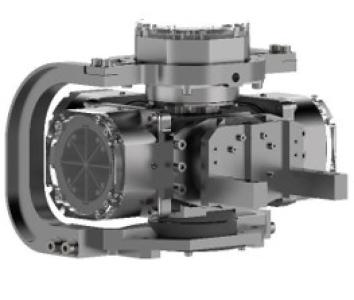
Develop a hardware image stabilization technology for planetary rover applications, allowing sharp imaging at high speed.
Description
The limit of autonomous locomotion velocity of a rover is dictated by actuator speed, terrain perception and planning. The actuator speed limit can be overcome by simple sizing of the actuator, depending on the mission needs. The planning limit for a traversable path can be improved by CPU (Central Processing Unit) and FPGA (Field Programmable Gate Arrays) computing acceleration.Perception is currently a limiting factor as the existing cameras for Martian and lunar applications have to be steady when taking pictures to ensure a sharp result. This requires the locomotion to stop, wait for the mast to stop oscillating until it can take a picture. If images can be taken while the rover moves, a substantial average speed improvement can be achieved.;A possible approach to take this burden away from the Concept of Operations (ConOps) would be to deliver sharp images while driving at increasing velocities via image stabilisation techniques. On terrestrial applications, stabilisation is obtained through various measures implemented in the camera hardware, such as camera mount stabilisation, lens-stabilisation (floating lens) and Sensor-shift where the sensor imaging area is actively moved in two dimensions.This activity shall employ the above techniques to achieve a breadboard of camera system for a planetary rover, capable to acquire images while the rover is in motion.;The activity encompasses the following tasks:- Survey of the state of the art of hardware image stabilization technology.- Develop requirements for the image stabilization performance and boundaries.- Produce a preliminary detailed design.- Produce a relevant breadboard design.- Produce the Software (e.g. based on open source libraries available for terrestrial use) implementing the camera control stabilization in any of the chosen approaches.- Manufacture and test hardware breadboard with the associated Ground Support Equipment (GSE).- Produce an analysis of the results comparing the performance with a conventional non-stabilized camera.- Produce a critical detailed design taking the breadboard test results into account.- Produce a path to flight analysis.
• Application domain: Earth Observation
•
Technology Domain:
13-Automation, Telepresence & Robotics
13-Automation, Telepresence & Robotics
•
Competence Domain:
6-Life & Physical Science Payloads, Life Support, Robotics & Automation
6-Life & Physical Science Payloads, Life Support, Robotics & Automation
• Initial TRL: TRL 2
• Target TRL: TRL 3
• Achieved TRL: TRL 4
•HarmoRoadMap: Automation and Robotics (2017.2)
•IPC Document: ESAIPC(2021)3
•Public Document: