HEBAM HEatbased Battery for the Moon
Programme Reference
20-D-T-TEC-03-g
Status
Closed
Country
Germany
Start Date
2021
End Date
2023
Programme: Discovery Prime Contractor: Azimut Space GmbH
Subcontractors:
DLR - German Aerospace Center • Germany
Description
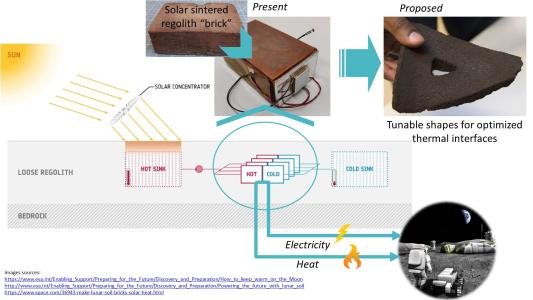
The project MESG: Moon Energy Storage and Generation, funded by ESA (Contract Nr. 4000119561/17/F/MOS), demonstrated the feasibility of using processed lunar regolith simulant to store heat and, while releasing it, to produce electricity. The possibility to use adequately processed (compacted and eventually doped) lunar regolith for this purpose is a key development on the path to make sustainable long-term lunar habitation a reality. In addition, the accumulated heat can also be used to keep a rover, or other asset, warm (via system scale-up) and extend its mission through the lunar night. During the previous technology development, a show-stopper for a possible “large scale demonstrator” was identified in the poor heat exchange to and from the regolith-based thermal storage mass. This aspect affects both the transfer from the heat source (e.g. concentrated solar energy) to the thermal storage mass, as well as at the interface from it to the heat-to-electricity engine as verified during a demonstrator test phase which showed a reduced electricity generation with respect to the expectations. Additionally, the trade-offs for lunar regolith simulant sintering techniques conducted in the project have been constrained by the availability of the processing machines, as well as their capabilities (i.e. processing/production sizes). This led to the demonstrator’s heat storage mass being manufactured with a conventional oven in air. The proposed project aims to continue the technology development from the current status, raise the TRL by mitigating some of the identified issues and verify the scalability of the technology through a larger scale demonstrator equipped with relevant technologies and materials compatible with the lunar environment. This technology development, since in most of the cases a thermal improved interface is also a mechanically improved one, can also be applied to other developments relevant for lunar colonization, such as outposts construction.
• Application domain: Exploration
•
Technology Domain:
22 - Environmental Control & Life Support (ECLS) and In Situ Resource Utilisation (ISRU)
22 - Environmental Control & Life Support (ECLS) and In Situ Resource Utilisation (ISRU)
• Initial TRL: TRL N/A
• Target TRL: TRL N/A
•Public Document: