Benchmarking re-entry prediction uncertainties (Parallel b)
Programme Reference
14-608-b
Status
Closed
Country
Italy
Start Date
2015
End Date
2018
Programme: Discovery Prime Contractor: Space Dynamics Services
Description
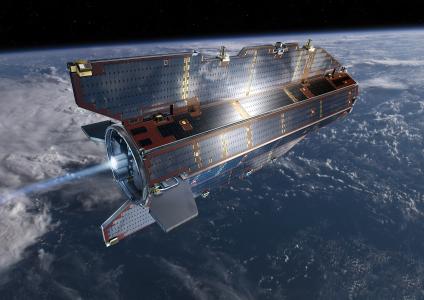
The project is dedicated to an in-depth study of the re-entry of ESA's Gravity Field and Steady-State Ocean Circulation Explorer (GOCE), for which a rich measurement dataset is available up to the very end of its decay phase.GOCE reached fuel depletion on 21 October 2013, at an altitude of about 225 km. As a result, GOCE started a natural decay which led to an uncontrolled re-entry on 11 November 2013 at 00:16 UTC (atmospheric altitude ~80 km). Incredibly, the spacecraft was still, most likely, fully functional for all the duration of the decay, apart from its 'drag-free' control system. This yields a rich dataset, that contains in particular a continous set of GPS measurements and attitude states, that has been collected by the spacecraft and downloaded up to the last pass down to altitude of about 100 km. Independent of ESA, many other sensors have followed GOCE during its decay phase, such as satellite laser ranging and ground-based radar systems (e.g. FHR TIRA).
• Application domain: Generic Technologies
• Initial TRL: TRL N/A
• Target TRL: TRL N/A
•Public Document: