General Relativity Experiment with Galileo satellites 5 and 6 (GREAT)
Programme Reference
15/710
Status
Closed
Country
France
Start Date
2015
End Date
2018
Programme: Discovery Prime Contractor: SYRTE
Description
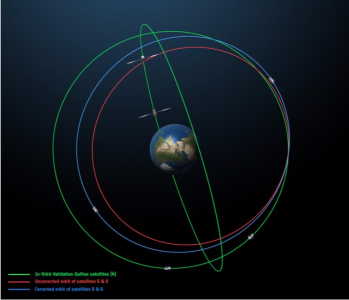
We report on a new test of the gravitational redshift and thus of local position invariance, an integral part of the Einstein equivalence principle, which is the foundation of general relativity and all metric theories of gravitation. We use data spanning 1008 days from two satellites of Galileo, Europe’s global satellite navigation system (GNSS), which were launched in 2014, but accidentally delivered into elliptic rather than circular orbits. The resulting modulation of the gravitational redshift of the onboard atomic clocks allows the determination of redshift with high accuracy. Additionally specific laser ranging campaigns to the two satellites have enabled a good estimation of systematic effects related to orbit uncertainties. Together with a careful conservative modelling and control of other systematic effects we measure the fractional deviation of the gravitational redshift from the prediction by general relativity to be (−0.14 ± 2.48) × 10−5 at 1 sigma, improving the best previous test by a factor 5.6. To our knowledge, this represents the first reported improvement on one of the longest standing results in experimental gravitation, the Gravity Probe A hydrogen maser rocket experiment back in 1976.
• Application domain: Generic Technologies
•
Technology Domain:
10 - Flight Dynamics and GNSS
10 - Flight Dynamics and GNSS
• Initial TRL: TRL N/A
• Target TRL: TRL N/A
•Public Document: