Robotic Digital Twin
Programme Reference
T309-701GD
Status
Closed
Country
Belgium
Start Date
2021
End Date
2023
Programme: TDE Prime Contractor: NETWORK RESEARCH BELGIUM S.A. - NRB
Subcontractors:
Fondazione Bruno Kessler • Italy
GMV AEROSPACE AND DEFENCE, SA • Spain
GMV INNOVATING SOLUTIONS SP. Z O.O. • Poland
Objectives
Improve robotic assets simulation models for on ground monitoring, predictive maintenance, model driven operations, effective operation/planning of the robotic asset (rover, arm, driller, etc.).
Description
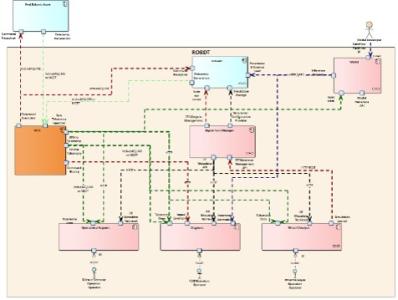
A digital twin merges a data model with AI (Artificial Intelligence) technology and the existing expertise. It hence allows for an unsurpassed level of monitoring via real-time and continuous assessment and evaluation, precise diagnostics, maintenance prediction, downtime prevention and maximised equipment effectiveness. The Digital Twin concept is getting more and more traction, and is envisaged notably for space missions or for spacecraft. The requirements for a robotic digital twin are nevertheless very different due to the different set of capabilities a robotic asset has compared to a spacecraft.Given the increasing number of future missions involving robotic assets (rovers, arms, drillers etc.), the aim of this activity is to develop a robotic digital twin. It will consist in a data model (hierarchy of systems and robotic asset components which describe the structure), along with a variety of data sources (real-time data, historical data, specific expertise and best practices), which will be the input of AI algorithms in order to create a software prototype of a robotic digital twin. AI algorithms will focus on Machine Learning methods.A Model Based Systems Engineering (MBSE) approach is seen as complementary to boost the use of such tool.The activity encompasses the following tasks:- State of the art technology analysis- Collection of data from different sources: METERON (Multi-purpose End-To-End Robotic Operation Network) experiments, simulators. Definition of the new tests required . Reference scenarios from ExoMars or SFR (Sample Fetch Rover of the Mars Sample Return mission) can be used in the model.- Consolidation of the use case analysis,- Software system requirements specification,- Software prototype development.
• Application domain: Exploration
•
Technology Domain:
13 - Automation, Telepresence & Robotics
13 - Automation, Telepresence & Robotics
•
Competence Domain:
9-Digital Engineering
9-Digital Engineering
• Initial TRL: TRL 1
• Target TRL: TRL 3
• Achieved TRL: TRL 4
•HarmoRoadMap: Functional Verification and Mission Operations Systems (2014.2)
•IPC Document: ESAIPC(2021)3
•Public Document: