Robust and (semi) Autonomous Platform for Increased Distances (RAPID)
Programme Reference
T313-702MM
Status
Closed
Country
Spain
Start Date
2021
End Date
2023
Programme: TDE Prime Contractor: GMV AEROSPACE AND DEFENCE, SA
Subcontractors:
HELLENIC TECHNOLOGY OF ROBOTICS SA • Greece
NETWORK RESEARCH BELGIUM S.A. - NRB • Belgium
UNIVERSIDAD DE M?LAGA • Spain
Objectives
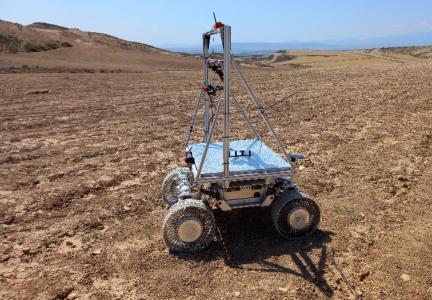
Design and prototype a rover capable of traversing the typical surface (regolith clad with scattered boulders and occasional outcrops) of the Moon and Mars, with a speed exceeding 1 m/s.
Description
In 50 years of Space Exploration, the total distance covered by rovers on Mars and the Moon is about 200km, an average of 4km per year. Future exploration rovers are expected to travel one or two orders of magnitude more.This requires designing rovers that are intrinsically faster than what has been built so far. As demonstrated in previous TRP activities high speed in semi-autonomous rovers can only be achieved by the optimal concurrent design of locomotion, navigation and Human-Robot Interface (HRI).Current rovers like ExoMars or the Sample Fetching Rover (for Mars Sample Return) have been designed for low speeds, in the order of cm per second.The RAPID rover will therefore require radical innovation, which will be pursued along 3 development streams:1/ Locomotion system: enable systems weighting hundreds of kilograms to attain average traverse speed exceeding 1 m/s, by employing suitable compliant suspension and compliant wheels,2/ Navigation system (including localization and mapping) software: fast and reliable localization and mapping, able to handle the target speed, working on low power budget. The navigation and locomotion capabilities should be developed considering future missions and mission objectives, e.g., sample collection, transportation and (un)pressurized rovers for crew transportation.3/ HRI: allowing both direct driving and supervisory control (e.g. waypoint driving), guaranteeing high situational awareness, suitable for high speed.A large portfolio of prior ESA developments can be used for the 3 streams.This activity encompasses the following tasks, to be structured according to the AGILE paradigm into sprints:- Identification of future missions objectives cases and requirements,- Iterative design, manufacturing and testing of the locomotion system, including mechanical design of wheels and suspension system,- Navigation system software development and test,- HRI design and development. Integration of MMI (Man-Machine Interface) elements such as touchscreen, physical control elements (control sticks, pads, other commercial solutions). The resources and ergonomics of the HRI design and the used MMI technologies shall allow usability of the HRI on the ISS.- Common integration sprints for the independent development streams. Demonstration of the integrated RAPID functionality and performance.
• Application domain: Exploration
•
Technology Domain:
13 - Automation, Telepresence & Robotics
13 - Automation, Telepresence & Robotics
•
Competence Domain:
6-Life & Physical Science Payloads, Life Support, Robotics & Automation
6-Life & Physical Science Payloads, Life Support, Robotics & Automation
• Initial TRL: TRL 2
• Target TRL: TRL 3
• Achieved TRL: TRL 4
•HarmoRoadMap: Automation and Robotics (2017.2)
•IPC Document: ESAIPC(2021)3
•Public Document: